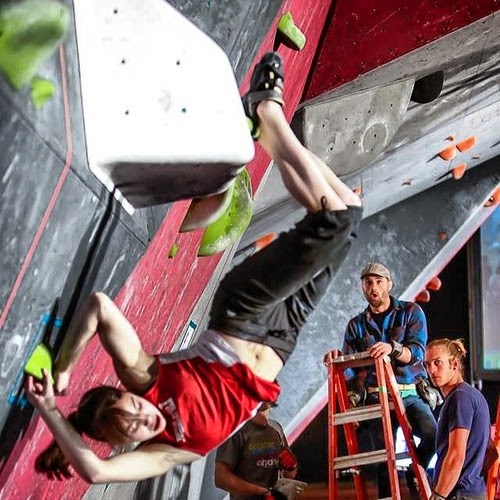
Ever since I can remember, it has been my dream to represent my country at the Olympic Games. Five weeks ago, that dream became a reality. I had the honor of traveling to Nanjing, China to represent the United States as well as the sport of climbing at the Youth Olympic Games. It was the single most important event I have ever attended, and the implications for the future of climbing are huge. For all purposes, it was the greatest experience of my life, and I count myself as very fortunate to have been able to live out this once-in-a-lifetime opportunity.
First of all, I would like clear up a few common misconceptions. This was
not a climbing competition. I was invited along with 15 other international athletes to promote climbing as a potential Olympic sport through demonstration and initiation for local residents, Olympic athletes, and the International Olympic Committee (IOC).
The Youth Olympic Games is the highest level of competition in Olympic sports for athletes between the ages of 14 and 18 (not to be confused with the
Junior Olympics, an event held annually in the United States). In order to qualify for the Youth Olympic Games, you must be ranked amongst the top youth competitors in the world in your respective sport, as well as not having competed in any Olympic event previously. The 2014 Games in Nanjing was only the third Youth Olympic Games to date, the first two having been in Singapore (Summer 2010) and Innsbruck (Winter 2012).
The initial aim of Youth Olympic Games was to accomplish several things: lower childhood obesity levels, foster a growing Olympic movement, and increase cultural awareness in youth athletes across the globe. The program was announced in 2007 by the former president of the IOC, Jacques Rogge, who ushered in a new era of Olympians at the inaugural Games in Singapore three years later. The sports featured there and at each successive Games consisted strictly of the events held in their senior Olympic counterpart, which meant climbing had not been a part of the action yet since it was not included in the Olympic program.
 |
| Jacques Rogge at the 2001 IOC Session in Moscow. |
Climbing has had its share of attempts at Olympic inclusion, beginning with the IOC’s recognition of IFSC (International Federation of Sport Climbing) as an official governing body in 2009. It was demonstrated unofficially in Torino in the 2006 Winter Games, and had initiation sessions at the 2012 Winter Youth Olympic Games. In 2013, climbing bid to become an official sport in the 2020 Olympic Games, but the bid was rejected in favor of wrestling, which had been ousted several months earlier.
Following the 2020 bid failure, progress appeared long and slow for the future of our sport. However, after the 2013 IOC Meeting in Buenos Aires, newly appointed
IOC President Thomas Bach presented climbing a huge opportunity: to showcase the sport at the 2014 Youth Olympic Games in Nanjing as part of a “Sports Lab” that would offer both exhibition and initiation to the general public and Olympic athletes alike. Included with sport climbing were rollerblading, skateboarding, and a Chinese martial art called Wushu.
 |
| President Bach at Sports Lab in Nanjing. |
The concept was simple: take four highly popular sports and have professional athletes in each field demonstrate the sport as well as help children try them out for the first time. It would run the entire length of the Games so that athletes who competed towards the end could still have the chance to try the sports out. In addition, the exhibition could provide insight to IOC officials and sponsors as to how popular each sport was from a viewing perspective.
Upon learning that climbing was going to be included in the sports lab, the
IFSC set out to create a team of 16 athletes from around the world who could represent sport climbing in Nanjing. Ten countries in addition to the host nation, China, were selected to nominate one male and one female athlete, of which the IFSC Executive Board chose the final team of 8 men and 8 women. When I got the call from USA Climbing that I would be representing the US at the Youth Olympic Games, it was probably the happiest moment of my life.
Prior to my trip, I made a quick visit to two of my favorite companies,
Clif Bar and
The North Face. Both have supported my climbing career in numerous ways, and it was great to have the opportunity to check out each of their offices and meet the people I had been working online with for years. It was also great to support local Bay Area brands for their continued sustainability and innovation, which we definitely pride ourselves with here in NorCal.
 |
| Clif Bar || The North Face |
Before I knew it, I was off to China! My parents and brother decided to join me on my adventure. I had never visited mainland China before (although I did go to Hong Kong when I was 2) so I was pretty excited about experiencing a new part of the world. The plan was to fly into Shanghai and spend a couple days doing some sightseeing with the family before making the 2-hour high-speed rail journey to Nanjing.
When we arrived in Shanghai after a brief stopover in Seoul, we were immediately greeted at the airport by my friend Kai Mu. I met Kai on a climbing trip to Rodellar in 2011, and we had climbed together in Boston while he pursued his master’s degree in engineering management at Tufts University. He moved back to his hometown of Shanghai after he graduated, and was really excited to take us around the city when he found out I would be coming. Needless to say, it was welcoming to see a familiar face after having traveled halfway around the world.
 |
| Myself and Kai Mu at center. Two psyched Chinese climbers on the left and right. |
The next few days were a whirlwind of exploration. In just two days, we managed to visit the Shanghai History Museum, the Imperial Gardens, the Peace Hotel, a market selling live birds and fish, a couple climbing gyms, and of course some delicious restaurants. Kai even convinced to get us to try some Shanghai delicacies such as pig’s feet, spiced duck blood (had the same consistency as tofu) and stir-fried frog.
 |
| The Bund, Shanghai. |
Although getting out in the city was great for getting over jetlag, there were several other challenges that China provided. For starters, the Chinese government intentionally blocked most forms of social media, including Facebook, Twitter, Snapchat, Instagram, and anything Google-related such as Gmail and YouTube. Another issue that I wasn’t prepared for was the subpar air quality, which prevented us from seeing the sun most of the trip. Apart from these minor nuisances, our stay in Shanghai was quite enjoyable.
The day of the opening ceremonies, Kai dropped us off at the train station in Shanghai and we made the speedy trip to Nanjing South Railway Station (the 2nd-largest railway station in the world). Upon arrival, I donned my athlete’s badge, which turned out to be a good idea. Volunteers for the Games spotted us instantly by my badge, grabbed our luggage, and shuttled us into our own private bus to take us to the Mingfa International Hotel, our place of stay for the duration of the Games.
After finally depositing my bags in my room, I ventured down the hall to the conference room to meet my 15 other teammates. I knew several of them from my years of competing, such as my Australian roommate Matt Tsang and Sam Stainton from South Africa, but I was not nearly as acquainted with the others. As soon as I walked in and introduced myself, it was immediately clear why each one of these athletes were chosen for their role. They each represented a major country and mostly spoke different languages, but they were all extremely friendly and excited to meet everyone. We all began chatting excitedly (in English) about recent climbing trips and competitions, animatedly miming beta with great enthusiasm. There was no denying it; each and every person in that room was just as psyched as I was to be there.
 |
| IFSC Team, Nanjing 2014 Youth Olympic Games. |
Once things had settled down, we had a briefing with the head IFSC officials at the event. Those in attendance included IFSC President Marco Scolaris, VP Debbie Gawrych, Chinese announcer Forrest Liu, the President of the Chinese Mountaineering Association, two sports managers, and two world-cup setters. They went over the expectations of the event and presented us with an extensive wardrobe of IFSC apparel to wear, in addition to a welcome bag full of goodies from the IOC. We changed into our new attire for the evening and headed off to the opening ceremonies.
The ceremonies took place at the Olympic Stadium at the center of town, and turned out to be one of the most spectacular performances I’ve ever witnessed. It was choreographed by visionary director Chen Weiya, the man who was also behind the extraordinary opening ceremonies of the 2008 Beijing Games. One of the highlights of the evening was an act in which about 100 or so performers, attached by cables to a massive crane, were lifted high into the night sky to execute some of the most amazing feats of choreographed movements I’ve ever seen.
IOC President Thomas Bach concluded the ceremonies addressing the athletes to encourage fair play and sharing passion for their sport, which he followed up with by taking a “YOG selfie” onstage with several athletes from various countries. We didn’t realize it at the moment, but the selfie set the precedent for the rest of the games in which thousands of athletes and fans from all over the world snapped photos of themselves with the hashtag #YOGselfie. It was clear how the power of social media was able to bring people together to share their Olympic passion.

Over the next 10 days, my life was completely consumed by the Games. Each day consisted of waking up bright and early to eat breakfast in the hotel’s luxurious dining area, then heading over to the sports lab at 7am to prepare for demonstrations. The sports lab schedule allowed for each of the four sports to have two 30-minute exhibition sessions (one in the morning, one in the afternoon), both sessions followed by a 30-minute initiation period for any local residents to try them out. We had a break in the middle of the day for lunch, but apart from that, we were climbing from 7:30am to 6:30pm.
 |
| World Champion Speed Climber Qixin Zhong helping with initiations |
During the exhibition sessions, many IOC Executive Board members observed climbing from the viewing area, and it was our job as athletes to explain the different disciplines to them and why climbing would make such a good Olympic sport. One of the major aspects that set climbing apart from other sports is the collaboration between the athletes to read beta during route previews, as well as the sheer verticality of the sport. Furthermore, the motto of the Olympic Games (“Faster, Higher, Stronger”) matched up perfectly to the three disciplines of competition climbing (speed, sport, and bouldering), making climbing easy to integrate into the Games from a marketing perspective.

At the end of every day, there was some time in which the sports lab was closed to the public where Olympic athletes could come participate in sports that were offered. During that time, we also got to try out the other sports, which was a blast. I especially enjoyed rollerblading, which I hadn’t done since I was a little kid. When the sports lab finally closed at 7pm, we would make our way back to the hotel to eat dinner, relax, or go watch some of the Olympic events.
As awesome as all of that was, it wasn’t all fun and games. Our packed daytime schedule left little time for rest, and the fact that we were climbing every day in 40°C weather and high humidity for four to five day stretches ensured we were absolutely exhausted by the end of any given 24-hour period. On top of all that, we had to keep energy in reserve for TV interviews, greeting members of the IOC, and pushing kids up the bouldering wall during initiation sessions.
© 2014 NBC Sports Network
Despite the constant physical exhaustion, we still managed to have a blast on our days off. We explored historical areas in Nanjing, tried out the cultural immersion booths at the Olympic Village, and hung out as a team after a long day at the wall. Being with such a diverse group of athletes was such a unique experience since we were from all over the world, but still had the same passion for climbing and could connect easily with each other. It was much different from being at a competition, since we were supporting each other as teammates in promotion of our sport.

After a couple days of working out the kinks of demonstrations, we faced our biggest challenge yet: the visit of President Bach himself. We all knew that it would be the ultimate test of our skills, since he had personally invited us to be there and could potentially decide the future of sport climbing. Leading up to the day of his arrival, we prepared by splitting up roles evenly between bouldering, sport, and speed. My responsibility was to do the first sport climb and make a dramatic fall near the top, leaving the way clear for my Austrian friend Andi to finish the climb (and throw a bat-hang in the middle) while the President looked on.
When the day finally came, the IOC surprised us by sending previous IOC President Jacques Rogge ahead of President Bach, which meant we got to climb in front of and speak about our sport to two IOC presidents in the same day. It was an experience I know I will never forget.
At long last, our time Nanjing came to an end. With heavy hearts, we bade farewell to all of our new friends at the closing ceremonies, and departed to our home countries the next day. Now that I have had time to reflect on the trip, I can genuinely say that my Olympic journey was the most powerful experience of my lifetime so far, and it allowed me to view climbing with a far broader perspective.
So what does this mean for the future of the sport of climbing? Based on what I've seen, Nanjing could've been the catalyst for climbing’s big breakthrough. If climbing gets admitted as an official Olympic sport, funding would increase significantly across the board, making it more possible to pursue professionally. Additionally, young climbers all over the globe will have a goal to aspire towards from the day they put on their first pair of climbing shoes: standing on top of the podium at the Olympics, a gold medal around their necks and their national anthem resounding clearly for the entire world to see.
However, the most important aspect of the Olympic Games comes from the fundamental concept of the Olympics themselves. The Games stand for more than just excellence in athletic ability; they provide an opportunity for young athletes to share their passion for their sport, meet others from around the world who share that passion, and realize that deep down, we as a human race are not so different from one another after all. If these leaders of the future understand this fundamental idea, the world will be a much better place to live in. For climbing, this global perspective is already ingrained into the culture due to the collaborative nature that sets our sport apart.
Having already been given the chance to experience the Olympics, my biggest goal now is to ensure that the next generation of climbers will have the same opportunity that I had. The current objective is inclusion in the 2024 Games, but given the success of the Sports Lab in Nanjing, we could be seeing it in the Olympics in some form as early as Rio in 2016. Our only option now is to wait and hope for the best outcome. No matter what the case, when our sport gets the break it deserves, I will be there cheering on my fellow climbers as they pursue their Olympic dreams.