Pages

Sunday, March 10, 2013

ABS14 Nationals: Training, Competing, Performing


Last weekend concluded the 2013 ABS National Championships. This year, I traveled out to Colorado Springs to compete in both the youth and open divisions, securing a semifinal bid in the adult category and my 5th National Bouldering Championship title in my last youth bouldering competition ever.

This two week Colorado experience has definitely been one of the best times of my life, and I am extremely grateful to be able to live out this lifestyle, balancing my studying with traveling and competing with some of my best friends. Now that I am able to look back and reflect on the trip, I can conclude that these results did not come without a great deal of training, competition preparedness, and mental focus.

A week prior to the Open National Championship, I participated in a 4-day training camp hosted by US Team Coach Shane Messer. This training was some of the best I have ever done before a national event given the time constraints of president's day weekend. Throughout the weekend, myself and 40+ other athletes from around the country did countless onsight drills, flash-format exercises, and crossfit-style workouts put together by Melissa Godowski. After the camp, I felt more mentally and physically prepared for nationals than I have felt any year before.

Step 1: Training: check.

Shane doing what he does best.
Photo: Emily Varisco
Earthtreks head coach Ellis Whitson getting some holds out for onsight training.
Photo: Emily Varisco
One of the most useful aspects that I got out of the camp was a routesetting perspective provided by Brent Quesenberry. If you didn't know Brent, you would never guess he's run 4 marathons and has more climbing expertise than most competition routesetters today. During one of his lectures on routesetting, he described the three influences on US bouldering competitions today: the Tony Yaniro style, (straightforward movements on directional holds) the showy American flair, (double-clutch dynos, bat-hangs, figure four's, etc) and the subtle European volume style that has begun to appear more and more often.

Brent (left) and Ellis being amazed by the climbing abilities of very small children.
Did you know Brent was also responsible for hand-building hundreds of wicked volumes and for this?!?
He's also one of the nicest dudes you'll ever meet.
Photo: Emily Varisco
The climbing abilities of Arabella Jariel (11 years old)
Photo: Emily Varisco
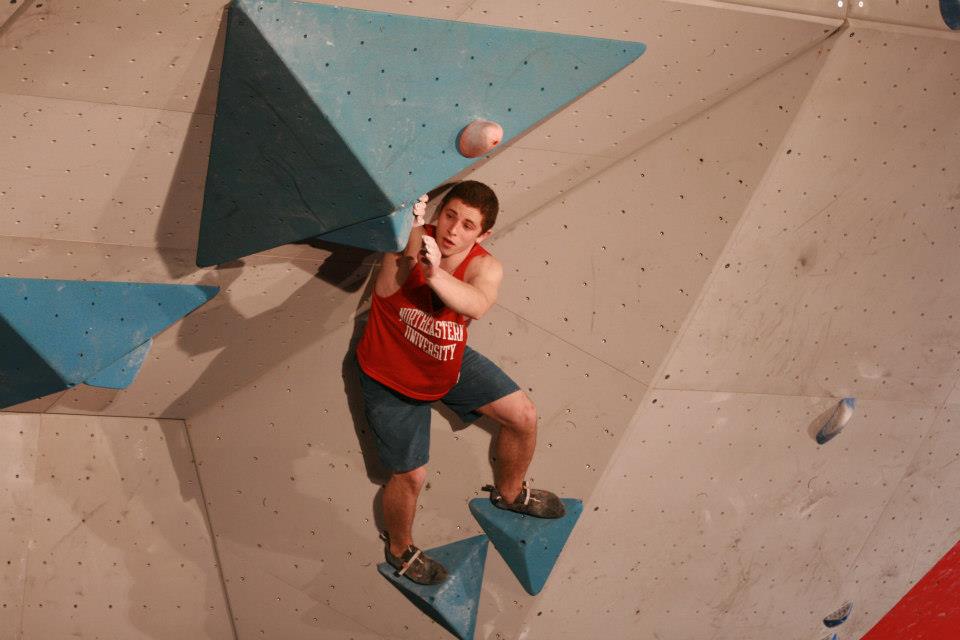
According to Brent, these three styles combine to form the modern-day US bouldering competition problem. This style was epitomized to a point by my 2nd semifinal climb in open nationals, in which competitors had to start facing the crowd and maneuver through hold-less volumes for 5 or 6 moves, then make a committing dyno to a good horn, then campus and power their way through the last couple slopers to the finish. When I turned around and saw this climb, I broke it up into three sections in terms of styles, which made it much easier to read and execute. Unfortunately, I was only able to get just past the dyno and ended up 19th overall in semifinals, but it was still my favorite problem of the competition.

Step 2: Competition preparedness: check.

Lots and lots of volumes.
Photo: Tom Condie
Photo: Tom Condie
The jump!
Photo: Dylan Huey
Photo: Climbingnarc.com
The only thing that was lacking for me to complete the climb (and potentially make it on to the final round) was lack of willingness to dig in. On any given day in training, I am confident I could have pulled off the move I fell on with a couple tries, but that is not how competition works. Comps are all about how well you can perform right NOW. The added pressure of these types of situations makes competition climbing all the more interesting, and rewards competitors for "bringing their man-pants" as Nicholas Milburn so eloquently puts it.

Nicholas Milburn brings his man-pants. Do YOU?
Photo: Tom Condie
Coming back the next weekend for the youth competition, I knew I had to put my try-hard face on in order to do better than the weekend before. Fortunately, in finals, I was able to borrow an iPod from one of my best friends (and now Vertical World team coach!) Alex Fritz, which helped me zone in on the three finals problems that the setters had prepared for us. With the added focus and pressure of finals, I was able to dial in my movements and complete all three boulder problems for the win! This time was especially gratifying since this is the last year I am eligible to compete in youth competitions.

Step 3: Performing under pressure: check.

Photo: Tom Condie
Now for the fun part! Here are some photos and videos from the event:

Charlie, once again proving his arms are larger than his legs.
Major props for him even competing this weekend, he pushed through 2 hernias to make finals!
Photo: Tom Condie
Brendan Mitchell winning The North Face Young Gun Award!
Super deserved, Brendan is one of the nicest and most humble kids in the sport today.
He also crushes 5.14.
Photo: Kim Mitchell
Photobomb: Tyson
Joe Gifford majestically reppin' the glorious country of TEXAS.
Photo: Tom Condie

Caption this photo?
Photo: Dylan Huey

Trying to figure out the correct beta on problem 2 in semifinals. This was not it.
Photo: Tom Condie

Me and my partner in climb, Cicada Jenerik!
It was both of our last years competing in youth after competing together for over 10 years.
Photo: Scot Jenerik


National Champs!
Photo: Tom Condie

Youth Highlights!
I would now like to take the time to thank my entire family for coming out and supporting me at this competition, it really means a lot that you've been there for me since day 1. I'm especially proud of my brother Yuri, who is now getting back into climbing after a 7-year hiatus, who competed in the citizen's competition alongside my dad! You go, bro. Everyone look out, we got another Levin on his way to the top.

Thursday, February 7, 2013

Dark Horse Championships!

This past weekend concluded the epic saga of the Dark Horse Bouldering Series. This year, Josh Larson and Dave Wetmore really stepped up their game, producing not two, not three, but FOUR heart-stopping, jaw-dropping, crowd-pleasing finals rounds that cumulated in the final championship round on saturday.

To kick the weekend off, my friend Nicholas Milburn flew in from Houston to compete, so we decided to pregame for qualifiers by going out for some delicious dim sum at a local restaurant nearby my dorm on Northeastern campus. Bright and early the next morning, we headed off to Metrorock after a solid breakfast at the dining hall in order for Nick to compete in qualifiers.

One of the unique aspects of Dark Horse is that if you are able to win one of the qualifying rounds, you automatically receive a bye into the finals of the championship. Having already qualified for the finals due to my win in round 2, I was able to relax during the qualification round on saturday and watch the action unfold.

The line-up.
Photo: LT11
Qualifiers were probably one of the most impressive redpoint sessions I've ever witnessed. Since its inception, the Dark Horse has grown in reputation and draws the strongest competitors from all over the country and even some internationally. This year was no exception, as professional climbers flew in from as far as Colorado to test their mettle against the boulder problems that Josh and Dave cooked up. By my count, at least 13 V12 and above climbers (not including the ladies) were in attendance, with only 9 of those being able to qualify for the finals. Just sitting in the crowd and watching as Daniel Woods, Paul Robinson, Carlo Traversi, and many others battled it out for a spot in the finals by flashing multiple V10's was certainly something you don't see every day.

After qualifiers ended, everyone headed to the back of the gym to watch finals. In the couple weeks leading up to the event, the hype for Dark Horse had been a crazy firestorm of videos and facebook updates from pro athletes confirming their spot at the event, as well as a secret surprise from Josh Larson & crew. When everyone finally entered the back area, the secret was finally revealed: Josh and Dave had built a brand-new competition wall that towered above the pumped-up crowd and demanded the attention of every single person in the building. I had known about its inception for the few weeks preceding the comp, but had not seen it with my own eyes.

The Dark Horse wall!
Photo: Jenna Keller
As the finals crowd grew to capacity, myself and the rest of the finalists got ready by making up ridiculous boulder and campus problems in our tennis shoes. It was pretty cool to be playing add-on with the strongest boulderers in the country, especially when someone [Jimmy Webb] starts doing one-arms on really bad slopers to warm up.

Finally, after the Louder Than 11 crew got their cameras rolling got the crowd amped beyond recognition, Dark Horse Finals began. When I turned around to face problem 1, it was hard to focus with the raucous mass of people behind me cheering harder than I have ever experienced in a climbing comp before. Even more intimidating was the fact that I was seeded directly after Daniel Woods, who set the bar fairly high, as you can imagine. The most intense moment I experienced was while I was sitting in the chair before problem 2, as every single climber on the wall topped their respective climbs at the same time. I thought my eardrums might burst.

Man of the hour - Bryan Rafferty MC'ing it up in finals!
Photo: LT11
Overall, I performed well, topping the first problem and making it decently far on the other three. However, on problem 4, I pulled my right-finger pulley tendon while attempting a rose move on a two-finger pocket, which made me stop climbing immediately. I was surprised when Jimmy Webb had the same issue, as he looked to be in a severe amount of pain after pulling the move. He also stopped two minutes before his time ended.

The infamous pocket.
Photo: Natalia Boltukhova
Isabelle Faus ended up taking the title for the women with a dominant performance over powerhouses Angie Payne and Meagan Martin. For the guys, D Woods pulled the comeback victory by flashing problems 3 and 4, but the true Dark Horse of the event was Nick Picarella with his outstanding tops of problems 1, 2, and highlight-reel flash of #4. Major props, dude!

All in all, I was still psyched! Dark Horse is by far the coolest local competition series that I have ever competed in, and completely lived up to all the expectations that I had. I got to get on some awesome problems and hang out with some of the best climbers in the world. Huge shout-out to setters Josh Larson and Dave Wetmore, and Jordan Shipman and Jon Glassberg from LT11 who have been essential to getting this series to where it's at now. Can't wait next season!

DARK HORSE.

Wednesday, December 26, 2012

Finals vs Finals: The Epic Showdown

By my count, over the past two months, I have been involved in exactly 11 finals of both the climbing and engineering variety. This includes 7 competition finals (1 Blackout Boulder Brawl, 1 Regional Championship, 2 Dark Horses, 3 Pan-American Championship finals) and 4 engineering final exams.  Now, who's to say which one was more challenging? There are certainly some interesting parallels between the two. Now that I am on break from school and the competition circuit for a bit, I now have the chance to reflect on my first semester of college experience and look back on how balancing a full competition load was on top of that.

Let's start back at the very beginning. When I was deciding on an undergraduate engineering program that I wanted to enroll in, I knew that climbing still had to fit in somewhere. My final decision to attend Northeastern University in Boston arose out of Northeastern's stellar engineering school and extensive co-op opportunities that the school is renowned for. I also liked the study-hard/play-hard atmosphere of Boston and the fact that the climbing community was extremely welcoming (not to mention the fantastic comps they put on). I assumed that my time at school would mainly be centered around my studies and that I would not have enough time/be motivated enough to actually get myself to the gym. Boy was I wrong.

Looking back, not only did I have the time to climb, I found myself more motivated than I ever have been in my whole life to get as much climbing in as possible, usually spending 5+ hours at a time climbing in the gym or outside at a New England crag. Instead of becoming a mindless training cycle, (as it had felt like in high school) climbing became my release from the many hours cooped up in my dorm or in class studying or taking notes. It felt natural, not forced, to have both my academics and my passion for climbing as the two center-points of my life.

Anyways, now on to what I was getting at. Finals. After completing quite a variety of them in close succession, (as described earlier) I have noticed many similarities (and a couple major differences) between competition finals and the final exams that I took at the end of my first semester of college.

Firstly, it is important to understand that not everyone makes it to finals. Finals are an event bound with exclusivity in both cases; qualifying for finals at any major climbing competition is equally as challenging as sticking out a class for a full semester. It is a given fact that some kids just won't make it, either by dropping the class, or not having the best day of climbing. It is also important to understand that it is OK to sometimes not make finals, and if you don't, to take it as a learning experience and to put even more effort into next time finals roll around. I haven't had to drop a class yet, but I almost found this lesson out the hard way in the Dark Horse competitions by qualifying in the very last spot into finals on two separate occasions.

Secondly, finals are all about knowing how to prepare yourself for exactly what you about to face. In my climbing experience, training on the IFSC speed wall before I went down to South America was essential in keeping the route beta fresh in my mind and retaining the necessary muscle memory for the route. The same lesson I applied to my training for Dark Horse, by practicing delicate slab climbs, huge dynos, and crazy Josh Larson-esque beta that only he would be so daring as to come up with. When it came time for my final exam in CHEM1151, (my general engineering chemistry class) I did a huge amount of practice problems that I knew were going to be similar to the material on the test, and I believe it helped enormously in my overall grade.

Finally, the most indispensable element in order to succeed in finals is adaptability. There is no way that every formula you memorized or every training move you executed will be handed to you on a silver platter (unless of course you are very lucky). Doing well in finals or on a final exam is 99% mental, since most finals are intentionally designed to bring you outside your comfort zone. When the problem looks too daunting to even approach, DO NOT PANIC. Think about what the creator of the problem is trying to get you to do. Then, take a step back, close your eyes, and take a long, deep breath. Once you have done so, break down the challenge (be it a boulder problem or calculus problem) into small, manageable steps that you believe will eventually lead you to the finish. Once you have decided on the manner in which you will attack, be confident in it, and proceed. If it fails, be adaptable and try a slightly different tactic (maybe it's actually a rose move! or maybe I should integrate by parts!) and try the process over again. Being adaptive to your surroundings will give you a huge advantage over a strategy of bashing your head into the wall by using the same approach time and time again.

That will pretty much do it for the similarities I found between my academic finals and competition finals, but there is one major difference that I would like to point out: In climbing finals, being the underdog in a comp is a good thing. There is way less pressure on you, so if you are a lower-seeded competitor in the finals, it feels as if you can make no mistake that would harm your current position. In my experience, being an underdog in a comp generally correlates to a much clearer mindset and a much better performance in the final round. This is absolutely not the case in academic finals. DO NOT be an underdog heading into the final by having a poor grade. Try to have the best grade possible beforehand to give yourself an extra point cushion should the final prove to be more devious than expected. Usually, grades in classes are cumulative, which means that even a good performance on the final does not guarantee you a good grade in the class, and it also puts a lot more mental strain on you at a time when you need your mind to be clear and stress-free. This seems like a very obvious statement to make, but I just wanted to show that there is indeed differentiation between the two types of finals that were previously mentioned.